Thursday, 4 September 2014

6 Powerful Tips to Boost Blog Conversions

Sometimes small things make a big difference
and what is the purpose of a blog anyway?
As you read this post until the end, you will discover 6 “leverage points” that you can apply to instantly boost your  blog conversions and turn them into a well oiled sales machine.
I use the word ‘sales’ because whether you like it or not, every single dollar you are going to make with your blog will be dependant upon your understanding of sales psychology and influence.
You are on www.bloggersmakemoney.com after all, so I’ll assume you’re okay with this.

Boost Blog Conversions Tip #1

Capture Leads Above the Fold

Here is what we mean by “above the fold” (screenshot taken at quicksprout.com)
boost blog conversions
Interesting enough, just like if your blog was a sales-letter, the purpose of the “above the fold” is 2-fold. (Pun intended)
  1. Interest the reader to actually read the blogpost
  2. Turn your visitors into a subscriber (lead)
This single change can improve your conversions by a LOT. (sometimes up to 35%)
This is the first thing I would do as a marketing consultant to boost blog conversions.

Boost Blog Conversions Tip #2

Give a Strong Enough Reason for your Traffic to Become your Subscribers.

boost blog conversions
That starts first with understanding what makes your target market tick.
When the “perfect visitor” comes to your site, what do you have that would make him say,
“I want that!” ?
You see, the are some things that your market will want desperately and if you can have an offer that resonates with that market, you are golden.
For example…
I’ve been studying the bed and breakfast market and I’ve found a very good sample of a high converting offer in this market.boost blog conversions
Now that is a high converting offer!Who would not give their email for a chance to win a free night?
Compared this to:
Exemple
Did I make my point clear? ;-)

Boost Blog Conversions Tip #3

Have a Clear Picture of Your Perfect Client

Blogging Blunder #3 Not having an avatarSo…who is it that you are talking to on oyur blog?
What is it that your perfect customer wants?
What is their biggest problem?
Do you have a clear and detailed picture in your mind of that person?
In marketing, we call that creating an avatar.
Do you remember the movie Avatar by James Cameron?  The film’s title refers to a genetically engineered Na’vi body with the mind of a remotely located human, and is used to interact with the natives of Pandora.
So this concept of creating an avatar can be applied to your business. But this time the Avatar is about being able to connect with your ideal customer’s needs and wants.
The world would be a lot better if more of us learned how to walk a mile in someone else’s shoes.

Boost Blog Conversions Tip #4

Targeted Traffic

As you grow your circles on Google+, building a fanpage on facebook and creating a following on twitter…are you paying attention to what kind of audience you are targeting? Are you doing it “on purpose” or are you “winging it”?
Are your partnerships with established bloggers based on understanding of how your target audience matches theirs?
For example…
My personal blog is targetted to the online home-based business niche and I am looking for people who want to quit their jobs…a natural fit is the Robert Kiyosaki audience. If you read the book “Rich Dad, Poor Dad”, you’ll know what I mean.
Bloggersmakemoney.com is also an obvious partnership.
Conversions happen when you get the right person…
in front of the right message…at just the right time.
This is the formula.
Who is that right person and what are you gonna do to get that person in front of your message?
Have a plan for that.

Boost Blog Conversions Tip #5

Returning Visitors

Obviously the #1 way to bring visitors back is to send them an email about the latest blogpost you made, and that should be the primary reason why you are building an email list.
Email is stillking in 2014 because no other medium can guarantee you to send your message successfully ~100% of the time.
It is the most reliable way to drive traffic.

Boost Blog Conversions Tip #6

Crazy Jedi Master Tip

Influence is a language.
Every word that comes out of you is either designed to attract or repel.
Your words are powerful beyond measure…if you know how to use them well.
Did you know that there is a language pattern for success and a language pattern for failure?
We have been programmed to communicate in a certain way since birth.  It may work for you…or against you.
I assume that you are doing your best to bring as much value to your readers as possible.
That’s a given.
But that’s only half of the equation, and language patterns are something I almost never come across as a topic. You can read this post about the power of words and how it influence your audience when you want to learn more about that.
Beware that what I am going to share with you right now is very powerful. It can be used for good and it can be use for bad.
Many people may discard it because of its simplicity.  Remember that sometimes small things make a HUGE difference.
I’ll give you the most powerful tip to make your readers beg for more, make them want to buy your book, hire you as a consultant and buy your affiliate offers.

Read and listen to audios daily.

What?!
Yeah you read that right.
Listening to powerful speakers on a daily basis makes you unconsciously absorb their language patterns.
You will find yourself starting to communicate like some of the most influential communicators and magic will start happening.
Garbage in, Garbage out. Good stuff in, Good stuff out!
When you decide to feed your mind with good stuff, over a period of time your language will start unconsciously to shift in a positive way.
But there is a whole lot more to it and you can watch this video to learn more.

Conclusion

I don’t pretend to know everything on the topic of how to boost blog conversions and I know that you’re smart. So if you have something I didn’t cover, please share in the comment box below. 
To view the original article Click Here

Tuesday, 2 September 2014

6 Backstage Social Media Platforms Every Marketer Should Be Using

By now, most marketers understand the importance of social media marketing; not only is it an inexpensive way to build a following and promote your brand’s content, but participation in social media could also become a major factor in the ranking algorithm for search engines like Google. If you’re like most marketers, you’ve focused on the “big three”: Facebook for the biggest audience, Twitter for the fastest updates and public profiles, and LinkedIn for the B2B business professionals.
In addition to the big three, there are a number of other social platforms that have gotten attention: YouTube is the biggest and most popular platform for any video-based marketing, and Google+ is used often because—let’s face it—it’s a Google product, and they reward its users with better rankings according tocorrelation studies by Moz and SearchMetrics. But there are countless platforms beyond the most popular options, with hundreds of millions of users between them, that most marketers aren’t taking advantage of yet.
Let’s take a look at some of the powerful social media platforms you can use for your brand beyond the major players:
 1.Pinterest. As I wrote in The Top 7 Social Media Marketing Trends That Will Dominate 2014, the popularity of image-based platforms is on the rise, and Pinterest is one of the best and most popular image-based platforms around. Pinterest’s format allows viral content to spread quickly, since its share feature “re-pinning” encourages fast travel from user to user, and there are no signs of the social powerhouse’s momentum slowing down anytime soon.
If your business has products that can be shown off with well-taken photos, Pinterest is perfect for you. Create boards revolving around your main product categories and promote your material in new, creative, or artistic ways. You can also create infographics or share pictures of your company if you don’t have tangible products in your business model. No matter what you do, keep your brand voice consistent and work Pinterest into a rhythm with your other social media profiles by cross-posting your images. The more consistent you are and the more visually appealing your images are, the better you’ll fare.
2. Instagram. Instagram is one of the most popular social media platforms around, with 200 million active users and an average of 60 million photos shared every day. Since Instagram is mostly populated with individual users sharing photos with their close friends and family, marketers have overlooked it as a viable social media option. However, the sheer number of users alone makes it worth exploring.
Create an Instagram account for your business and connect it to your company’s Facebook and/or Twitter account. Instead of using the Pinterest strategy of showcasing highlights of your products and services, use Instagram to demonstrate the personal side of your brand. Take pictures of your office and coworkers, and of any events you are attending. Use hashtags wherever it’s appropriate (just don’t overdo it) and engage with other users on a regular basis by commenting on their photos and responding to their comments on yours.
3. Tumblr. With over 130 million blogs, Tumblr is a blogging powerhouse, yet it’s still overlooked by most marketers. Tumblr used to be a semi-underground refuge for teens and young adults looking for a new way to express themselves, but since Yahoo purchased the platform for $1.1 billion in 2003, its “hotness” factor has started to wane.
That doesn’t mean it’s no longer useful. Think of Tumblr as a social version of a traditional blog. It’s a new outlet for you to publish and distribute your content, and since other users can connect to your blog with ease, it’s easier to build long-term connections. The best way to use Tumblr is as a niche division of your brand—for example, Target uses Tumblr to advertise and promote different fashions associated with the brand. Tumblr users do tend to prefer images and videos over written content, but it’s a good idea to use both if you want to attract the largest possible audience.
4. Sulia. Sulia is a relatively new platform that’s attempting to segment and filter the endless stream of content that social media users tolerate. Twitter feeds and Facebook feeds in particular tend to be filled with unnecessary updates and pooled results, forcing users to embark on a hunt to find the content that’s relevant to them. Twitter lists attempt to control this by allowing users to segment who they follow, but Sulia is an entire platform dedicated to a more refined experience.
Sulia is a content platform like a communal blog, but it allows users to categorize their content and search based on user-tailored “suggested posts” and posts that are trending within the community. With Sulia, you can write to a focused section of your audience and build a more relevant readership. You might get fewer readers with Sulia compared to a mainstream publisher, but the types of readers you get will be more relevant for your brand and therefore, will be more likely to convert.
5. Bubblews. If nothing else, Bubblews is a great business idea. Instead of posting all its own content or relying on its users to generate free content it can leverage, Bubblews shares all its ad revenue with its contributors. Right now, there aren’t that many people using Bubblews, so the revenue being shared is miniscule and the readership is limited. However, as it grows, there is a key opportunity for brand promotion.
Think of Bubblews as a guest blogging platform that can generate a separate stream of revenue. Write, post, and syndicate your content regularly on Bubblews and you’ll get the benefits of greater visibility and more possibilities for links and external brand mentions. Plus, if your content is catchy and starts to become popular, you’ll receive a share of all the ad revenue it helps to generate. Again, right now you can’t count on much revenue to come in, but over time, Bubblews could evolve to become a formidable platform in the social media world.
6. Snapchat. Snapchat started back in 2011, but because it’s been used mostly for personal exchanges, it’s slipped by the eyes of most marketers. However, as I mentioned in my article Your Guide to Using Snapchat for Marketing, about 400 million snaps are sent each day by about 26 million users in the United States. Pictures and videos sent via this app are self-destructing as a privacy measure. That means your target audience will only have a few seconds to read and remember your message. In a way, that’s advantageous considering the painfully low attention span of your average user—it’s a way of almost guaranteeing their attention for those few seconds. But at the same time, you need to compress your messaging to ensure it is memorable.
Compared to other image-based apps, Snapchat is somewhat less efficient. It takes more time to follow and get to know your potential users, and it takes significant effort to create an image or message that will only last for a few seconds. Still, it’s worth considering as part of your broader strategy.
You certainly don’t need a presence on every one of these platforms in order to run a successful social media campaign, but if you want the most relevant audience and the best potential results, it’s important to think outside the “Facebook, Twitter, LinkedIn” box.
To view the original article Click Here

Monday, 1 September 2014

How to Grow Your Email List With Facebook: 7 Easy to Implement Strategies

I’m finally getting around to watching the recordings from Social Media Marketing World 2014 and these notes came from the presentation by Amy Porterfield.  
Amy started her presentation by acknowledging the issue with Facebook reach and said that it’s time for a Mindset Shift:  Facebook is an Investment.
Start to look at Facebook differently and become one of the few to make BIG strides and impact on Facebook.
“Business is 80% psychology and 20% mechanics.” ~Tony Robbins
If you can get the psychology down, the mechanics is easy
She also said something I agree with wholeheartedly:
Tweet: “The energy of your business is directly tied to your email list.” ~ @AmyPorterfield #SMMW14 via http://ctt.ec/5H3PN+
Your number one focus should be growing your e-mail list. Facebook is the place where you turn Fans into Leads.

Use Graphsearch to Find Targeted Pages

Use Graphsearch find out where your audience is spending time on Facebook -type in “ Pages liked by People who Like ___your Page___” (or another page)
Facebook Graphsearch

I also have a post here about Facebook Graphsearch:  3 Interesting Uses of Facebook Graphsearch
Engagement: How does Facebook determine engagement:
  • Likes
  • Comments
  • Shares
  • Clicks
These must happen consistently or you do not make it into the News Feed

How to Get Engagement on Facebook

She talked about Native vs. Non-native posts:
Native posts are non-intrusive and shows that “you are one of them”.  It keeps people on Facebook.
native Facebook post
Non-native-It’s ALL about ME and redirects people to somewhere else
Non native Facebook posts
Quotes and meaningful messages can help get Likes and Shares
quotes on facebook

The Facebook Lead Strategy

1: Create an irresistible giveaway
A free webinar is a great freebie that people will sign up for.  Make it packed full of great tips for your audience.
2: Create an optin 
She recommends Lead Pages leadpages.net
Sidenote:  I like Leadpages because it’s easy to use but if you can create an optin page on your own site, do that.
3:  Set up an “Unpublished” news feed ad
You can also just do a Promoted Post that appears on your Facebook Page if you aren’t comfortable working with the Power Editor.
The Unpublished Post:
-everything is clickable
-everything is customizable
-image is large enough to grab attention:  1200 x 627 pixels and only 20% text
-separate campaigns for fans and non-fans
Ad Placement: ONLY put your ads in the News Feed
Audience Targeting: in the Interests box put in all the results you got from your Graphsearch
Unpublisehd Post
Unpublished post details
 4: Deliver the giveaway and then use email marketing to seal the deal
At the end of the webinar spend about 10 minutes going over your $97 product to sell.
5: Email marketing
You must use e-mail marketing to help you sell.
What to expect:
1: From fan to lead $1-$5
2: From non-fan to lead $3-$8
3: From lead to customer $10-$30
4: Daily spend $50/ day-(even $10/ day is an option)
Great information from Amy Porterfield! Make sure you connect with her at www.AmyPorterfield.com
If you need more tips on how to use Facebook Ads take a look at all my Facebook Ad posts and my Facebook Ad services.
What are your thoughts – have you used this strategy on Facebook?  How has it worked for you?  Share your thoughts in the comments below!
To view the original article Click Here

Sunday, 31 August 2014

10 Lessons Marketers Can Learn From the ALS Ice Bucket Challenge

ice bucket challenge marketing lessons
If you haven’t been digitally detoxing, you have probably seen your friends (and some celebrities) dumping ice over their heads, challenging others to do the same, and in some cases donating money to ALS.
It seems everyone has a point of view on the challenge itself, but whether or not you’re a fan, it’s hard to deny the massive reach – and financial impact.Whereas last year the ALS team raised $2.6MM, this year donations to ALSA have topped $88MM (over the same time period, July 29 to August 26) and are still pouring in.
For many marketers, it’s a dream case study in the making: An increase in donations by over 800%, organic celebrity involvement, a rise in conversation, and endless amounts of content that can be shared on brand channels.
So what can you learn from the success of the Ice Bucket Challenge?

1. Keep the barrier to participate low.

Almost anyone can procure ice and water. There’s no entry mechanism, no specific form to fill out, no file format to remember, no site where you have to upload your video. All you have to do is use your smartphone to film yourself and tag/invite others using the social media platform of your choice.

2. Build in personal invitations.

In some ways, this is a classic case of peer pressure. The challenges issued to individuals aren’t sent via an email bot; Instead they’re said directly to camera, from a friend, to the public. It’s much harder to ignore an ask from someone who you know, especially when they’re only asking two other people. And because individuals are tagged, their social stream will also see the challenge, adding in a social shaming element for those who choose not to participate.

3. Use a strong – and specific – call to action. 

Inviting others helps build in social spread, but there’s genius in the wording as well. Issuing a challenge is more likely to inspire participation than merely suggesting others partake.

4. Urgency is motivating.

No one gets anything done without a deadline. By giving people 24 hours to participate, it deters people from putting it off and forgetting about it. Of course it’s hard to inspire urgency if you’re asking for something complex.

5. Content should be short, digestible and entertaining – but doesn’t have to be branded.

Most videos themselves are under 60 seconds, and let’s face it, it’s fun to watch people dump ice water on themselves. The videos aren’t about ALS, or the research that is ongoing, and most people are tagging their content with #IceBucketChallenge, a hashtag that doesn’t include a nod to the ALSA or the disease itself.
And still, it’s working: This Google Trends chart shows that as the Ice Bucket Challenge has increased in popularity, so have the number of searches for ALS. In fact, more people are searching for ALS than for the Ice Bucket Challenge itself!
ALS ice bucket challenge google trends

6. Celebrity endorsements can act as a tipping point.

It used to be that you needed to be picked up by mainstream media to make a grassroots campaign go viral. But these days celebrities (and other influencers) are media channels themselves with not only a strong reach, but arguably a more engaged audience than many traditional media vehicles.

7. Use the Benjamin Franklin Effect to your advantage.

It’s a psychological phenomenon showing that someone who has already done a favor for someone is more likely to do another favor for that person than if they had received a favor from that person.
Lost? Originally, the Ice Bucket Challenge went like this: Donate money OR dump ice water on your head. But many people, after dumping ice water on their head, are still donating.
The Benjamin Franklin effect says that by doing a single favor (like the pouring ice water on your head to build awareness for a cause), you’ve subconsciously told yourself that whoever you were doing the favor for is worthy. And after you’ve done the first favor, you’re more likely to support them again (maybe by donating money, for example.)

8. Money isn’t front and center. 

Perhaps the donations are in some ways the most surprising success metric: After all, most videos challenging others don’t link to the organization or even name the ALSA.
Money is clearly a part of the challenge, and donations have indeed skyrocketed, but no one is begging you to donate. (Take note, politicians!) And while many people who participate in the challenge are doing both, there’s an opportunity to participate for those who don’t have the disposable income to donate, without associated guilt.

9. Originality is a myth.

At Genius Steals, we believe originality is a myth: that nothing comes from nothing. And the ALS Ice Bucket Challenge is a perfect example. The Ice Bucket Challenge originated as a way to spark charitable donations, but wasn’t tied to ALS specifically.
One participant named ALS as their charitable cause, and others decided to go with it instead of changing the charity. You don’t need a “never been done before” idea to spark interest and participation.

10. Join existing conversations instead of starting your own. 

It’s content marketing 101, and ALSA owned it. This “campaign” wasn’t started by an ALS organization. Instead, after seeing that participants were naming ALS in their videos, the ALSA jumped on board.
We’re sure to see a number of copycat campaigns this year (MacMillan Cancer Support has already launched their own Ice Bucket Challenge), but instead of hosting another Ice Bucket Challenge, why not pay attention to conversations from people who care about your cause? How can you join their conversations and build in cultural relevance to spark awareness and donations that rival the Ice Bucket Challenge?
To view the original article Click Here

Saturday, 30 August 2014

No More Click Bait: Facebook Explains How to Share Links

Facebook announced changes to their ever-changing News Feed algorithm that will impact the way brand content is distributed.
AGAIN.
Of course, this will certainly impact some brands more than others. Some are likely to take a hit in traffic. Others could see an improvement in referrals.
What happens to you depends on whether you’ve been sharing links the way Facebook has long recommended and whether you choose to ignore these final warnings.
Facebook says no to click baiting and explains how to share links properly...
CLICK TO TWEET

Stop Click-Baiting, Stupid

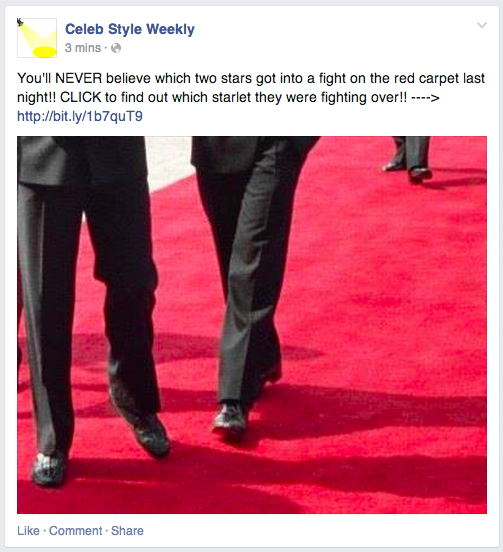
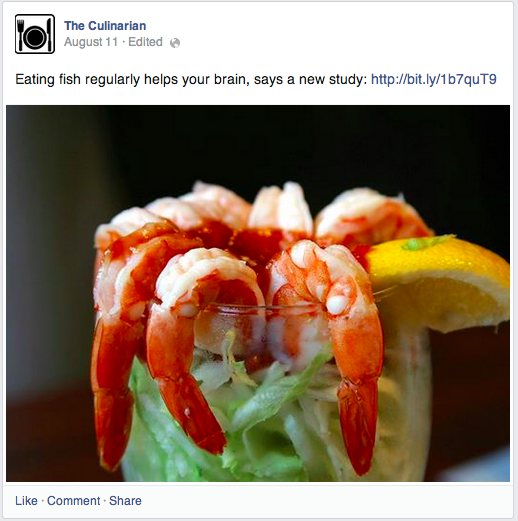
“Click bait” is when a link is shared with a title that entices the user to click without telling them what the article is actually about. Here’s an example…
click bait facebook No More Click Bait: Facebook Explains How to Share Links
This type of content has become extremely successful on Facebook lately since users can’t help but click to find out what the article is actually about. Titles often include phrases like “You won’t believe what happens next!” and “What this guy does is amazing!”
This type of content gamed Facebook’s News Feed algorithms. Since Facebook observes engagement signals to determine what content users will see, click-bait articles have been taking over the News Feed.
Of course, that doesn’t necessarily mean that people want to see this content. The purpose of click bait is to get a user to click the link, resulting in more people seeing that story and clicking it as well. But in reality, many users clicking were leaving unsatisfied.
And since these articles have been taking over the News Feed, they have been preventing users from seeing content they actually want to see. That, of course, is bad.
Facebook surveyed users and found that 80% preferred links with headlines that helped them understand what an article was actually about. As a result, Facebook is making a change.
Facebook says that over “the next few months,” distribution of this type of content will be negatively impacted. It’s not clear when this will begin or if it already has.

How Facebook Detects Click Bait

This is a question that is sure to arise. The truth is that it’s not in the words of your title but whether you deliver on your promise.
From Facebook’s announcement:
One way is to look at how long people spend reading an article away from Facebook. If people click on an article and spend time reading it, it suggests they clicked through to something valuable. If they click through to a link and then come straight back to Facebook, it suggests that they didn’t find something that they wanted. With this update we will start taking into account whether people tend to spend time away from Facebook after clicking a link, or whether they tend to come straight back to News Feed when we rank stories with links in them.
Another factor we will use to try and show fewer of these types of stories is to look at the ratio of people clicking on the content compared to people discussing and sharing it with their friends. If a lot of people click on the link, but relatively few people click Like, or comment on the story when they return to Facebook, this also suggests that people didn’t click through to something that was valuable to them.
So while the focus is on click bait, it’s really about directing users to content that they spend the time to read and then come back to Facebook to share it with their friends. These would be signals to Facebook that you are sharing valuable content and it should be shown to more people.
On the flip side, if Facebook sees that an article with a high number of clicks is resulting in low time away and few shares with their friends, you can expect such an article will get less distribution in the future.

Share Links the Way PEOPLE Do

Click bait is one example of brands attempting to take advantage of an algorithm to improve performance of their content, even if it lacks value. Another is the way they’ve been sharing links.
For a few years now, brands have taken note of the fact that photos and text updates tend to get more reach and/or engagement than a standard link share (pasting in the URL and allowing Facebook to pull in a thumbnail, title and description). As a result, they saw an opportunity.
You’ve undoubtedly seen brands share boring text updates with a link in it, but no link preview. This was done in an effort to reach more people because their results showed that Reach was higher with text updates than link shares.
Brands will also share a large image and attach a link within the description like this:
facebook photo link No More Click Bait: Facebook Explains How to Share Links
The theory was that photo posts received more engagement, so they “performed” better than a standard link share. So brands shared links in this way to get that additional reach and engagement.
Of course, most brands sharing in this manner were neglecting an important metric: Website clicks. Were they actually driving more website traffic in this way?
According to Facebook’s research, they weren’t. In fact, links shared with a preview like the one below were getting double the clicks…
facebook link share No More Click Bait: Facebook Explains How to Share Links
The confusion centers around the word “clicks.” Brands think they are getting better success from the photo share because it gives them more photo clicks, but rarely will it provide more link clicks.
As a result, Facebook will begin favoring links shared with a standard preview as opposed to with an attached photo.
Bottom line: Users don’t share links in this way. The reason brands are doing it is due to a perceived weakness in the algorithm.
I encourage marketers to give their methods some additional thought. Facebook is a social network. Users are kings. You should think twice about sharing in ways that are unnatural to the user.

How This Impacts You

Marketers tend to overreact whenever such news is announced. Let’s not get crazy here.
If you previously only shared links with a photo, you should consider changing this. It doesn’t mean the old method won’t reach anyone, but you should take a very close look at your metrics to determine what is and isn’t working for you.
It doesn’t mean you should stop sharing photos. I have a photographer friend who benefits from that extra real estate within News Feed to share his photos. He swears he gets better results all around when he shares photos with links in them. He should continue to do so, but he should also split test it against the way Facebook intends.
I have little sympathy for those who use click bait. Yes, it “works.” But as a user, it’s freaking deceiving and annoying. I’ve grown tired of seeing these titles in my News Feed and I’m glad Facebook is doing something about it.
End of the day, you need to provide value. You need to follow through on the promise you made with your share. And you need to make a user’s experience on Facebook better.
If you fail at that, you can expect that your content will be punished.
I’ve preached a very simple approach from Day 1: Share content that is helpful, educational or entertaining. Do not deceive. Do not prioritize posting method over the content. And do not chase an algorithm.
Those who follow these simple rules care very little about changes like the ones described above.

This Shouldn’t Be News

I’m actually a bit exhausted by this. I’ve been encouraging people to share links the way Facebook intended for years now. I wrote this post in February of 2013, begging you to stop using text updates and photos to share links.
Few listened.
Facebook wants to highlight the best content. They need users to have a good experience, see the content they want to see and spend more time on Facebook. Fewer users online and less time on site will lead to less advertising revenue.
Within the past year, Facebook has repeatedly rolled out algorithm updates that reward authenticity. They found that memes and asking for likes were throwing off the News Feed, so they made an adjustment in August of 2013.
They found that like-gating was resulting in people seeing content they didn’t necessarily want to see, so they ended that practice recently.
Maybe these changes anger you. Maybe they will be a wake-up call.
In reality, you should have expected it. Anything that results in an artificial inflation in distribution or doesn’t authentically reflect a user’s interests does not benefit user experience on Facebook.

Your Turn

What do you think of these changes? Are you impacted?
To view the original article Click Here