Tuesday, 26 August 2014

Tips to Make Money With Social Media


make money social media


Wouldn’t it be awesome if we could upload a picture of a cat with a propeller hat on a skateboard and make $ from it?
Well, some companies are…indirectly.
cat skateboardThink about it, if a news company like Mashable makes money off web quotas (pageviews/unique visits/etc.) and a cat picture on Facebook sends 50,000 people to their site, that cat picture is profitable!
Now, let’s take a small business like Any Size Basket (they make baskets). If they were to post that same cat picture on Facebook, all it might do is get a handful of shares, “likes”, maybe even a few new followers. If they’re lucky, maybe some visits to their site. Is this profitable, even indirectly? Nope.
But if that cat was gliding down a mountain in a custom-made ski-basket, then yes, at least indirectly, this picture could fuel some conversions (and more social traction).
cat money gangster
What about selling sponsored social media? Did you know cost per tweet prices are public information?
How much would you pay for a sponsored tweet from The Next Web? Their Alexa traffic rank is 1,058 in the U.S. so I guess that’s pretty good…but I’d pay five bucks. Why? Because on average, their tweet gets 150-250 re-tweets by random people.
You know where I can get hundreds of irrelevant retweets for five bucks? Fiverr. I honestly don’t see the difference. With a follower count at about one million there’s too much noise and no way of guaranteeing the ability to reach a target audience.
So how much does The Next Web charge per tweet?
tnw tweet cost
Yep, that’s right, $3,500 for most likely irrelevant exposure and a minuscule traffic spike. Can someone justify this to me?
Okay I’m done ranting, if people are actually buying this then kudos to The Next Web. That’s an insane profit per tweet.
Hustling tweets and pushing social shares isn’t really the job of a social media marketer; although it can seem like it at times.

What is a social media marketer?

According to popular definition, social media marketers basically have one broad goal: to increase traffic and/or exposure. But that goal is evolving. For the past three years we’ve seen a marketing outcry to get a dollar sign in there.
Personally, I think the goal should just be fluid, like public relations.
You can use social media marketing to fulfill a business goal (make money), gain exposure, or even change a disposition. Maybe your brand got a lot of bad press – social media marketers can help change that.
The existence of a “social media marketer” as a real job was initially laughable. It challenged all pre-conceived ideas of what social media was about. In a way, those who were laughing simply didn’t understand how a business could be “cool”.
Those same people expected social networks to fail after a few years of hype (which is true in some cases) because they couldn’t be visualized as profitable.
But here we are, it’s almost 2014 and companies of all sizes have employees with titles like “Executive Blogger”; “Growth Hacker”; “Social Media Rockstar” – you get the idea.

How do social networks make money?

Here’s a quick question: how much time do you spend on average driving your car per day? What about on social networks?
For many people, these numbers are close and when people invest this much time in something, it’s generally profitable.
But we have to pay for cars – social networks are free.
neilsen report
via Neilsen
The social network standards for making money are:
  • raising venture capital/financing rounds
  • outside investments and donations
  • paid advertising
  • get bought out by a larger company
  • membership/subscription fees and premium business accounts
  • miscellaneous fees (i.e. Facebook’s developer application fee)
These are all the popular dollar streams flowing through social networks and keeping them afloat. Without them, social networks would inevitably fade into the dark abyss of the web.
Fortunately, many manage to stay afloat, allowing businesses to take advantage of their platform and reach potential customers.

Successful companies using social media

Red Bull
redbull fb page
Sitting at over 41 million likes, the Red Bull Facebook page has straight rocked social media.
One of the biggest reasons for their success is the initial brand messaging goal they set in place when they kicked off their social media campaign.
When we hear Nike we think just do it.
We we hear Red Bull we think gives you wings.
Both companies demonstrate the values and what it means to have wings. The media they post is focused on a lifestyle – not a brand.
redbull flugtag
Red Bull has many “extensions” of its main Brand Page. For example, the Red Bull Flugtag community page which is entirely dedicated to their awesome Flugtag event.
redbull fb extensions
And here’s the full list of their extensions, which includes all of their media assets. Essentially, they are making money from a huge investment in social media by reinforcing brand qualities, increasing awareness, and really owning the social landscape for their brand.
Skittles
skittles tweets
If we’re being honest marketers, we can mostly agree Skittles tweets > our tweets.
They just want to have fun!
And that goal seems to be the trend a lot of companies don’t understand. It’s the million dollar question:
How are going to make money from ‘having fun’? Do you really think smiles and sunshine and rainbows will increase revenue? WHAT’S THE ROI OF A RAINBOW?!?!
We need to break away from that mindset – not completely, but just for social media. People are spending their OWN time on social networks for their OWN goals. Marketers and advertisers can’t expect to profit from users with traditional practices, such as billboard manifestations as valueless sidebar ads.
Social media marketing is really evolving into a form of befriending people to market to them…hmm, maybe I should coin that term…befriend marketing…

List of social networks you should be considering for niche targeting

LinkedIn groups – There are over 1.5 million LinkedIn groups but the trick is to find the gems; the rare groups that have active members and proper management. How do you find these gems? Basically, search for groups that meet your niche keywords, such as (mobile advertising and New York) and comb through discussions until you notice the same members commenting/contributing on a regular basis. Check out the Group Stats to make sure the group is aged a bit (not some recent marketing ploy). Finally, jump in. See my description about subreddits below for ways to actually make money from being social.
Facebook Groups – There’s something about joining a “private group” that gives it an appeal unlike anything public. Maybe it’s the mystique of exclusivity but private Facebook Groups are excellent and creative ways to make money from social media. A friend of mine was invited to join a private Facebook group hosted by a market research group. They invited a select demographic (male, 21-26) and performed a type of virtual focus group for a set block of time. Later, my friend was raving about a new soda flavor that might come out. Indirectly, that brand is making money by building up anticipation and curiosity – the product didn’t even exist.
Google+ Communities - These are more media-based then social-based (like LinkedIn). Again, just search for relevant niche topics, join active communities, and contribute with value-added media and articles. The stuff you post can be straight from your site – as long as it’s adding real insight. Obviously you can’t just plug a product, but an in-depth case study about how a business profited from this product would be interesting to check out right?
A Few Niche and Useful Social Networks 
Ravelry - [from this site] a place for knitters, crocheters, designers, spinners, weavers and dyers to keep track of their yarn, tools, project and pattern information, and look to others for ideas and inspiration. The content here is all user- driven; we as a community make the site what it is. Ravelry is a great place for you to keep notes about your projects, see what other people are making, find the perfect pattern and connect with people who love to play with yarn from all over the world in our forums.
Classmates - [from the site] an online home for your high school class. With the largest directory of high schools and class lists available anywhere, covering 57 million people and including maiden names, Classmates makes finding, reconnecting and staying up with your high school class fun and easy. Classmates also has over 200,000 digitized high school yearbooks available for you to view and share photos.
Subreddits - this is the most overlooked place to make money from being social. Forget the media part. Join a community that fits or relates to your business niche and contribute to discussions. Demonstrate expertise and help people asking questions. Ask questions of your own. After awhile you’ll notice opportunities to name-drop your product; such as setting up an exclusive discount for the subreddit or holding a contest. Some members will even direct/private message you asking for additional advice, which is a great time to subtly recommend/mention your business.

Ways to make money with money on social media

Facebook Ads

Facebook’s advertising platform and algorithm cater ads to be more helpful than irrelevant. It’s a great way for new local businesses to gain exposure or for existing ones to get the word out about a new development.
One of the leading Facebook marketers, Brian Carter, lists 5 acquisition steps to make money from Facebook:
1) Someone clicks on your FB Ad, directs to a sales/landing page, they make a purchase/sign up.
2) Someone clicks on your FB Ad, directs to become a fan of your Page, they see an interesting post, they click-through to your website and make a purchase.
3) Someone clicks on your FB Ad, directs to a Squeeze Page, they sign up for email, they open a future email pitch, they click-through to your website and make a purchase.
4) Someone clicks on your FB Ad, directs to become a fan of your Page, they see an interesting post, they opt-in to receive texts/SMS discounts, they make a purchase with discounts.
5) Someone clicks on your FB Ad, directs to become a fan of your Page, they see an interesting post, they click-through to your website and click one of your onsite Ads.

These are simply the models; the main idea is that Facebook ads are like a fishing net. You can cast it to catch the attention of people who *most likely* might be interested in your business/service.
Even though Facebook Ads have a lesser value than  call-to-actions on your site, they are still versatile and attractive because they’re reaching *possibly relevant* people in a different environment.
One of the biggest cons with advertising on a social network is that no matter how *good* your Ad is and no matter how *relevant* it is, people just don’t care. This is and always will be the hot button issue with social networks. The only reason we use them is for the core values and functionalities that existed when they first released – we never cared (or asked) for Ads. But if you’ve been paying attention to social media marketing these past few years, you’ll notice the difference between a *good* Facebook Ad and a *poor* one is:
  • good Facebook Ad seems like something your friend might say
  • poor Facebook Ad looks like an Ad

PTP Programs

This is a rather *unethical* way to make money with social media (hence no links) – so we’ll just give you an overview. PTP or Paid-to-Post programs is literally micro-working for scrap change. You get paid to *do* social media. You get paid to:
  • like things, comment on things, sharing things, and post things on Facebook
  • tweet things, retweet things, favorite things, and post things on Twitter
  • blog things, reblog things, comment on things on sites
  • vote things up (or down)
Basically, you just get paid to click stuff. Sounds good right? Sure…if you’re okay with making pennies per click. Give it a month and the Carpal Tunnel surgery will do you over.
I’m not suggesting PTP Programs are the least bit viable; but they exist as a way to make money with social media. It’s the *founders* of PTP programs that are making money by offering things like “50 Guaranteed 100% All-Natural Organic Facebook Comments”

Celebrity Partnerships

Digital media agencies have been capitalizing on the potential of social media by forming relationships with brands and their clients, who are often celebrities.
As I previously mentioned, simply paying for a celebrity or high profile twitter account thousands of dollars for one sponsored tweet is futile and just plain dumb.
Instead, agencies are catching on with best practices and even paving their own path.
Example: The famous actress Felicity Huffman has her own website blog thing; “WhatTheFlicka”. She scored some bucks doing a write-up for Mattel and more importantly, Mattel received a celebrity endorsement. I mean the post received close to non-existent social traction; but now Mattel has a write-up about their summer program – it’s better than a tweet if you ask me.

YouTube Gold

Here’s where all the social media money mines are located.
  • Creating a YouTube account and channel is free.
  • Gaining an honest subscriber count is hard
  • Creating *awesome* content is harder
  • Consistently creating awesome content is the hardest
I recently read a comment from a YouTuber who makes a living off his videos. He has two revenue streams:
  1. Ads
  2. Sponsored/Paid product reviews
His comment described how after creating 100 high quality videos (about video games and PC gaming) over the course of one year his subscriber count was at a whopping 97. He was making scrap change off Ads at this point and doing free product reviews…
His advice? Don’t give up.
Soon after, his videos finally caught the attention of larger game review sites and fellow YouTubers in his niche with larger followings. Two years later (today), his subscriber count is over 6,500. His videos net 10,000+ views and he gets paid to do reviews now.
That’s just one success story as a result of tenacity and diligence.
We often forget what social media really entails.
  • This is social media.
  • So is this (hit the forward button once it loads).
A website is a media form. A site like the 1st example is social in nature.
What does it mean to be social in nature?
Exactly what you’re thinking; people will naturally talk about and share it.
We often overlook the simplest things that can be redesigned as potentially viral social media:
Some of the most successful examples are sole page sites that are created to be social in nature, with subtle references to an ulterior goal.
In fact, there are tons of people rocking it on social media.
What are your favorite examples of people doing social media right?
To view the original article Click Here

Social Media Is Silencing Personal Opinion – Even In The Offline World


Social media is not living up to its promise of being an online outlet for discussion that mirrors our communications and conversations that take place in the offline world. In fact, people are less willing to discuss important issues on social media, than they are in real life, a new report from Pew Research Center has found.
It may seem like an obvious conclusion: of course, people are more hesitant to speak up with a contrary opinion when all their friends, family or colleagues feel differently. But there’s been little research that quantifies just how unwilling people are to take a potentially unpopular stance on outlets like Facebook and Twitter.
Pew refers to the this tendency to keep opinions to yourself, when you believe they’re not widely shared, as the “spiral of silence” – a term coined in the mid-70’s by a researcher studying the nature of public opinion.
“Some social media creators and supporters have hoped that social media platforms like Facebook and Twitter might produce different enough discussion venues that those with minority views might feel freer to express their opinions, thus broadening public discourse and adding new perspectives to everyday discussion of political issues,” explains Pew.
But as it turns out that optimistic desire is not the quite reality. If anything, social media is encouraging users to keep opinions to themselves.
In its study, Pew focused on the controversial topic involving Edward Snowden’s revelations of widespread government surveillance, because that topic saw a variety of opinions across the U.S. as to whether his actions were justified, and whether the government’s policies themselves were good or bad.
Only 42% of users said they were willing to discuss the surveillance program on social media, while a much larger 86% were willing to have an in-person discussion about it. Meanwhile, the 14% who were unwilling to discuss the topic in person didn’t turn to social media as a backup – only 0.3% did.
PI_14.08.26_spiral-silence-01
This, explains the report, “challenges the notion that social media spaces might be considered useful venues for people sharing views they would not otherwise express when they are in the physical presence of others.”
And in both online and offline discussions, people were more willing to share their views if they believed their audience agreed with them. For instance, if someone believed their Facebook network agreed with them, they were twice as likely to join a discussion about the issue.

Silencing Effect Extends Offline

But here’s the kicker: not only did social media silence users online, or fail to be a place where they could more freely discuss topics when they couldn’t do so with real-world friends, it also seemed to change people’s offline behavior, making them less willing to engage in potentially controversial discussions.
Social media users, says Pew, were less willing to share their opinions in face-to-face settings than others. The typical Facebook user was half as likely to have a discussion about the topic in the offline world, while Twitter users were 0.24 times less likely to do the same.
Of course, it’s worth pointing out that the choice to use the Snowden situation as the basis for this particular study could be flawed – after all, social platforms, including Facebook, were implicated as being among the places the government tapped to listen in on citizens’ conversations. Perhaps citizens didn’t want to publicize an opinion on this particular matter, but would be more willing to do so on others.
The study, for what it’s worth, didn’t get into the “why” question regarding people’s decision to stay silent, but theorized it could be attributed to a number of factors, including not wanting to disappoint or get into arguments with friends or post things that HR departments or prospective employers could one day discover. Plus, Pew says that an individual’s decision to share an opinion could also relate to their confidence and understanding of the subject as well as how intense or apathetic they felt.
Because of its sample size (1,801 people) and choice of topic, Pew’s study might not be a fully accurate example of social media’s silencing effects, but it’s definitely fodder for discussion – if you dare! – as well as further research.
To view the original article Click Here

Thursday, 21 August 2014

What's Next For Twitter?

Screen Shot 2014-08-20 at 16.33.30
Twitter bounced back from a rough start to 2014 with a positive array of Q2 results, reporting stronger-than-expected financials and continued user growth. But what are Twitter’s next steps to further monetise the platform and stand strong amongst its competitors?
Attracting users – and keeping them interested
Twitter can update its platform to make life easier for brands, but ultimately, its success depends on attracting users and keeping them interested. Even Twitter itself admits that it isn’t the most user friendly social platform, and it has been reported that the vast majority of people that sign up for Twitter don’t use it that frequently.
Twitter’s timeline is a big part of this problem, having received a lot of criticism for being over-complicated and not aesthetically pleasing. In recent months, Twitter has made an effort to make its service easier for new users to grasp. It has been spotted trialling hashtag translations, and have released embedded tweets-within-tweets. Such features allow users to understand tweets better, as well as tidy up the interface.
Screen Shot 2014-08-21 at 10.38.37
CEO Dick Costolo also suggested there is a possibility of Twitter following in Facebook’s footsteps and incorporating an algorithmic timeline, a change that would certainly make Twitter easier to digest. However, Twitter’s USP has always been the fact that the content you see is of-the-moment and timely. Filtering posts would make it easier to follow, but would perhaps move Twitter towards a bit of an identity crisis as it gets a little too close to Facebook.
Twitter’s video strategy
Social video is a welcome alternative to untargeted TV placements and offers brands a more measurable alternative that’s become popular with advertisers. Facebook has been busy bolstering its video offering, and YouTube’s revenues continue to grow strongly. Twitter, however, still has a surprisingly low amount of video content. That’s now likely to change.
Previously, advertisers could target their video content on Twitter using user data, and we’ve seen a growing wave of embedded sports-related videos ads from brands like ESPN. But this option has so far been less accessible than competitor offerings.
Twitter recently announced its native video product – “Promoted Video”- to make it easier for brands to upload and share video content, helping them measure distribution and effectiveness. New, enhanced metrics will bring Twitter up to speed as a video platform, bringing them on par with Facebook and YouTube.
Screen Shot 2014-08-21 at 10.43.02
Twitter’s promoted video content will not autoplay in the feed in the way that Facebook’s new Premium Video Ads do. Users will instead be able to click on what they want to watch and view it in their timeline. The feature comes on a cost per view pricing model - an attractive feature for marketers looking for set returns, allowing them to pay each time a user clicks to watch the video.
Twit-commerce
Twitter has the potential to be the ultimate impulse purchase platform, and has been introducing a range of features to bring the platform to the fore of social commerce.
The platform has been keeping us guessing recently with tests of a ‘Buy Now’ button, users spotting a ‘Payment and Shipping’ button and its acquisition with CardSpring, a card start-up that links companies to bank cards and tracks online activity to offline purchases.
Screen Shot 2014-08-20 at 16.45.18
It has also been actively working with brands to build partnerships that demonstrate the viral power of the platform, such as Starbucks’ tweet a coffee and Amazon’s #AmazonCart.
Twitter’s retweet function offers users an instant and very easy method of sharing content. This viral nature puts the platform in a strong position when running e-commerce promotions, with the potential for tweets about offers and products to spread quickly.
This is an area where Twitter has potential to lead the industry with innovative solutions for advertisers, rather than merely keep up with Facebook’s offering. Its recent acquisitions and developments are glimpse of things to come, but as always, this needs to be carefully balanced with keeping users happy.
Ad targeting
Twitter lacks the huge amounts of personal user data that Facebook holds, meaning it can’t deliver targeted ads with the same degree of accuracy.
Recent updates and acquisitions suggest Twitter is counteracting this, adopting other methods of analysing its users to better target ads.
Last year Twitter introduced a new website tag for remarketing, helping marketers create tailored audiences from website visitors. It also acquired a digital ad exchange MoPub to boost its location-based mobile advertising offering, now an important part of Twitter’s overall business. This has allowed Twitter to connect its 270+ million users to billions of monthly mobile ads served by MoPub, broadening Twitter’s mobile ad ecosystem. This is a key part of Twitter’s long-term revenue generation strategy (and a big part of why Q2 was such a success for the platform).
More recently, we’ve seen updates to SocialRank, its analytics service looking into influential and engaged users, to now search users by location and keyword searches. The recent acquisition of image search company Madbits will also help Twitter analyse its users via their photos, offering more accuracy when targeting ads.
Following its ‘Promoted Video’ offering, Twitter continues to offer marketers even more control with its recent launch of performance-based tools, making it easier for marketers and SMBs to measure and optimise promotions. Twitter’s ‘objective-based campaigns’ mean marketers pay only for actions that meet objectives – like driving followers, tweet engagements and app installs. It is the next logical step in Twitter’s transition from a primarily branding, to a direct-response platform.
The future
It’s clear that Twitter is under pressure on a number of fronts, but it does seem to be working hard to improve its service, attract and keep users, and offer more to brands. We’ve already seen a marked improvement from Q1 to Q2; recent moves and acquisitions seem to indicate that Twitter is not only keeping up with the crowd, but showing potential to lead the way by building on its strengths.
To view the original article Click Here

25 Vital Facebook Stats for Social Media Marketers

facebook stats header
Facebook is a massive social networking platform that reaches into nearly every aspect of users’ online and offline lives. This networking giant acquires businesses that offer features it doesn’t currently have, and is constantly morphing into something that transcends social media. When you think online marketing, it’s nearly impossible to miss Facebook. In fact, many businesses consider Facebook their only online marketing strategy – although we shouldn’t put all our eggs in one basket - but this reliance on the platform demonstrates just how influential it is.
The follow 25 Facebook stats provide insightful data points all marketers can leverage – whether it’s convincing a client to sign on for a social media campaign or creating facebook-specific content.
  1. There are 1.01 billion mobile active users (MAU) on Facebook. It’s more than likely that your audience is using Facebook on a mobile device. Keep a “mobile first” mentality, and make it easy to access content linked from Facebook. Your website or blog should be ready to handle users who visit your site from Facebook. (Source: TechCrunch)
  2. Mobile advertising revenue represented 62% of advertising revenue in the second quarter of 2014. This is especially interesting information for app developers. Using Facebook news feed ads, you can drive app engagement and installs. Facebook even allows you to link to specific areas of your app directly from the news feed. (Source: Facebook Investor Relations)mobile facebook ads
  3. Ages 25 to 34 represent 29.7% of users and are the largest age demographic on Facebook. This age range represents a prime demographic for most marketers. Your market is there, but you’ll have to do your part to get them engaged with your brand. Find out their needs and what they’re interested in, then craft content that speaks to them. (Source: EMarketer)
  4. Nearly $1.2 billion of Facebook’s revenue comes from US and Canada.
    Facebook is making money because advertisers are making money. A good Facebook marketing strategy can help your brand tap into this income stream. (Source: Bloomberg)
  5. The highest Facebook traffic occurs mid-week between 1 and 3 p.m. Your focus should be on reaching your Facebook audience when they are on Facebook. Use this bit of information to know when and how to schedule your posts and other content on Facebook. If you’re using automated social media posting apps, be sure to keep these timeframes in mind. (Source: Bit.ly blog)
  6. Engagement is 18% higher on Thursdays and Fridays. This, again, is valuable content scheduling information. While engagement is higher, these days also lead into the weekend. Produce content that will stick, so your audience will remember you on Monday. (Source: Bit.ly blog)
  7. Facebook users spent $234 million dollars worth of virtual goods and gifts on Facebook over the last quarter. This is more exciting news for app developers. But this is also good for businesses that use virtual gift cards and gift certificates. If you aren’t yet, it’s definitely worth looking into. (Source: Facebook)
  8. 293,000 statuses are updated, 136,000 photos are uploaded, and 510 comments are posted every 60 seconds. Your job is to get your brand in the midst of all this engagement and activity. If your content is relevant and engaging, users will share it (source: The Social Skinny). For example, MenuDrive – an online and mobile ordering software company – posts originial and thoughtful content on their Facebook page instead of propaganda or advertisements. This type of content is engaging: menudrive facebook post
  9. People search 1 billion times per day on Facebook.
    Drive need and want for your product, service or content. When users feel connected to your brand, they will look for it on social media. Make sure you’re present there when they search. (Source Facebook)
  10. 80% of the top apps on iOS and Android use Facebook Login. There’s good reason for this. Users like the convenience and ease of logging in to an app or website with Facebook. Just having this feature substantially increases registrations. Even in the face of privacy concerns, users still find themselves choosing the useful feature. (Source: Facebook)
  11. Creation of local business pages has increased 100% from 8 million in 2012 to 16 million in 2014. Even small businesses realize the marketing potential of being on Facebook. But presence isn’t enough; you have to reach out to your audience. Before even considering ads, your business should certainly be taking advantage of free pages for business. (Source: Facebook)
  12. Promoted posts totaled 7.5 million from June 2012 to May 2013. This demonstrates, again, that business Facebook users are taking advantage of the huge market Facebook offers. (Source: Facebook)
  13. Businesses spent $2.66 billion on Facebook advertising, which represents an increase from $2.27 billion last quarter. When executed correctly, Facebook ads can drive leads to your business’s website. Just understand that Facebook ads should only be one part of your online marketing campaign.
  14. 654 million people use Facebook mobile on a daily basis, an increase from 609 million last quarter. A large part of your marketing should be geared toward mobile users. Mobile use is on track to surpass desktop use, but many marketers neglect this segment. (Source: Facebook)
  15. Monthly Facebook access increased from 1.28 billion to 1.32 billion since last quarter. This fact just reemphasizes that users are very active on Facebook. (Source: Facebook)
  16. Facebook users are 53% female and 47% male. The key understanding here is that, in a practical sense, there is an equal opportunity to reach both genders. Females edge out male users only slightly. But if you’re brand is seeking a mostly female audience, you’ll easily find them.  (Source: Emarketer)
  17. Facebook revenues totaled $.86 per user from Europe and the rest of the world. If your business has an international audience, your efforts to reach them certainly won’t be lost on Facebook. The mega social media site transcends borders, which is a major opportunity for businesses that want to go international with their marketing.
  18. Users share 4.75 billion pieces of content daily as of May 2013, a 94% increase from August 2012. Again the evidence makes it clear that people are engaged on Facebook, and it only continues to increase. Position your brand by contributing relevant content that is easily shared. Make it easy for website visitors and blog readers to share information with buttons. You can even go so far as encouraging them to do so (source: Facebook). Take the CAT dealer Gregory Pooleas an example of how a seemingly “silo” industry can use Facebook to promote content that isn’t self-serving:poole themed facebook posts
  19.  4.5 billion likes are generated daily as of May 2013. Some of the most liked content on Facebook also has the most comments and shares. While you want likes, comments and shares, aim to get them legitimately. Do this by crafting content that speaks to your audience. (Source: Facebook)
  20. Ad costs per unit have increased 122% since just last year. This has to do with Facebook’s ever-expanding list of acquirements, users and revenues. As they grow, we can expect that ad costs will follow suit. If you’re a small business, take the time to really consider if Facebook ads are the next step for your business. (Source: Facebook)
  21. 1.5 million businesses purchase Facebook ads. Many businesses see the benefit in purchasing Facebook ads. This doesn’t mean that it’s for every business. Also be sure that your ad campaign on Facebook follows through with leads. That includes making sure your ads are really working for you and sending a clear message to potential customers. (Source: Facebook)
  22. The average time spent per Facebook visit is 20 minutes. Facebook users don’t mind hearing what you have to say, but you’d better make it short and sweet. Quality doesn’t equate to length. If the average user is only spending 20 minutes on Facebook in a single visit, make it so that you get your point across quickly. Or make your content interesting enough that they’ll want to save it to read later. (Source: Infodocket)
  23. The average Facebook user spends 40 minutes a day on Facebook. In a whole day, that isn’t very long. Having been bombarded with content and information from friends, family and businesses, you’ll be lucky to be amongst the content the user actually engages with. To increase your chances, create strong content.
  24. Videos are watched and shared on the Facebook news feed twice as much as just six months ago. Diversify your content. While images are still king on Facebook, videos appear to really be taking off, and your brand should take advantage. (Source: Facebook)
  25. 42% of marketers say that Facebook is critical or important to their businesses. Facebook is a crowded place. But you can’t sit back while your competitors are interacting with your audience. The key here is to create a unique space for your brand that users are drawn to and recognize apart from all the others. (Source: State of Inbound Marketing 2012)
As you can see, Facebook’s massive reach offers the audience and the means to contribute and share information. If you want potential customers to notice, take the time to produce content that engages, inspires and informs. These Facebook stats are convincing for many clients who are on the fence about allocating some of their budget to a social media campaign. Before Facebook increases their ad costs again, it would be wise to make the case for clients.
To view the original article Click Here

Wednesday, 20 August 2014

Facebook Ad Dayparting: Schedule Specific Times and Days to Run

One question I’ve repeatedly received from advanced Facebook advertisers involves dayparting: They want the ability to choose which times of the day to advertise and eliminate undesirable times.
Such a request comes mainly from those familiar with Google AdWords, where the feature is available. The thought is that certain times of the day are more effective than others, and dayparting limits waste.
Such a feature was not available for Facebook advertisers. Until now!
Dayparting is now available to Facebook advertisers: Choose specific times of day...

Use Power Editor

First, know that this functionality is currently only available in Power Editor.
While the main ad create tool has closed the gap lately in terms of functionality and is more useful than it’s been before, this is yet another reminder of why you need to be using Power Editor.
This feature will undoubtedly be rolled out to the ad create tool eventually, but it’s not there now. And if you want to advertise like the cool kids, you need to use Power Editor.

Schedule on Ad Set Level

You’ll be able to select specific times of the day to run your ad from the ad set level. Remember that ad sets allow you to set budget and start/end dates for a group of ads.
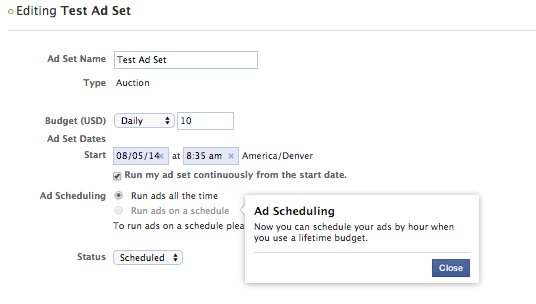
When you are in an ad set an “Ad Scheduling” notification will appear to you…
facebook power editor ad scheduling Facebook Ad Dayparting: Schedule Specific Times and Days to Run

Ad Scheduling Tour

Facebook will take you on an initial tour…
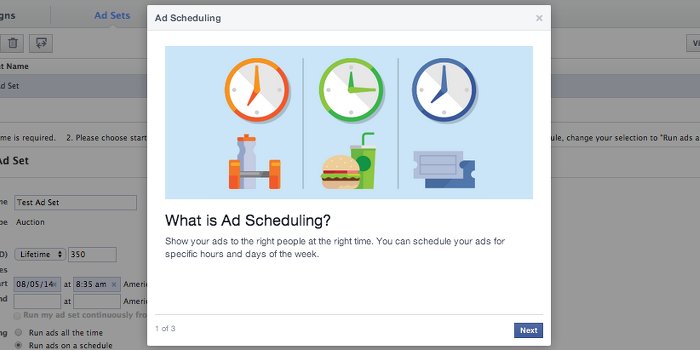
What is Ad Scheduling?
Show your ads to the right people at the right time. You can schedule your ads for specific hours and days of the week.
facebook ad scheduling 1 Facebook Ad Dayparting: Schedule Specific Times and Days to Run
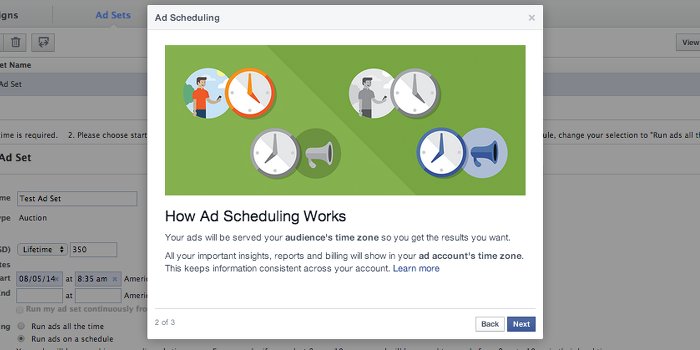
How Ad Scheduling Works
Your ads will be served your audience’s time zone so you get the results you want.
All your important insights, reports and billing will show in your ad account’s time zone. This keeps information consistent across your account.
facebook ad scheduling 2 Facebook Ad Dayparting: Schedule Specific Times and Days to Run
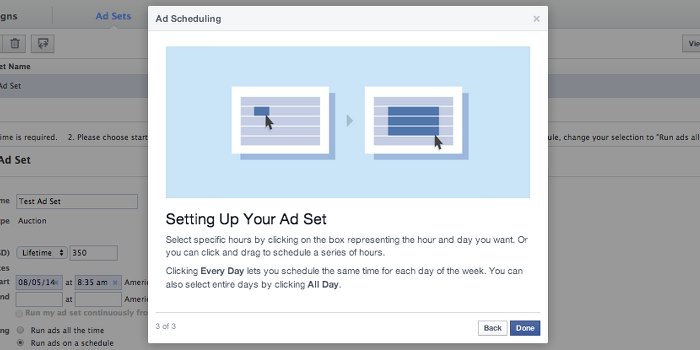
Setting Up Your Ad Set
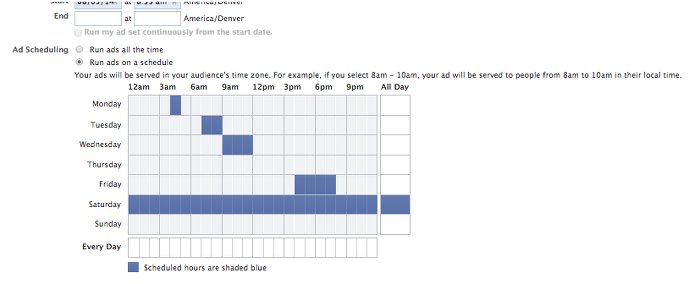
Select specific hours by clicking on the box representing the hour and day you want. Or you can click and drag to select a series of hours.
Clicking Every Day lets you schedule the same time for each day of the week. You can also select entire days by clicking All Day.
facebook ad scheduling 3 Facebook Ad Dayparting: Schedule Specific Times and Days to Run

Hands On

Note that you can only run this type of scheduling when you select “Lifetime” as your budgeting option. I don’t personally use lifetime, so this will be an adjustment.
You’ll want to select the radio button for “Run ads on a schedule.” Then manually choose the specific times and days you want your ad(s) to run.
facebook ad scheduling power editor Facebook Ad Dayparting: Schedule Specific Times and Days to Run

Dayparting on Facebook: What You Should Know

I’ve always been skeptical of the feature. The reason is that I’ve felt that some advertisers have had the wrong motivation for using it.
For example, they’ll assume their audience is online between 10am and 6pm, so they’ll want to focus their ads during those times. But does it really matter when your audience is reached?
Well, that’s the question this will answer. It’s possible, for example, that certain audiences are more likely to read than interact at certain times. Or they may be more likely to buy during non-work hours.
But keep in mind that this will limit your audience. For example, let’s assume your ad was originally going to be shown to four groups of people during the course of a day, based on when they are online:
  1. Group 1: Midnight – 6am (25 people)
  2. Group 2: 6am – 12 Noon (25 people)
  3. Group 3: 12 Noon – 6pm (25 people)
  4. Group 4: 6pm – Midnight (25 people)
All four groups can be reached in this original way of scheduling on Facebook.
But now you decide that you only want to reach people between noon and 6pm because you’ve determined that this time is most effective.
The result? Instead of potentially reaching 100 people (25 in each group), you can now reach a max of 25. This will certainly impact distribution.
As it is, many advertisers are complaining about a decrease in impressions lately. This can partly be blamed on the larger (and fewer) sidebar units. It can also be blamed on increased competition.

Just be aware that scheduling in this manner may cut the distribution (or at least potential distribution) of your ads even more.