Showing posts with label Making Money with Facebook. Show all posts

Tuesday, 9 September 2014

After 1.5 Million Posts Analyzed, Here is the Perfect Facebook Post!

The Perfect Facebook Post
Do you know how to craft the perfect Facebook post?
Being on the Facebook News Feed has become as hard as being on Google’s first page.
The fierce competition and recent changes in the algorithm are turning this almost impossible, and what makes the difference often times comes down to small details, testing and optimizing every single aspect of your content.
TrackMaven analyzed more than 1.5 million pieces of content on 6,000 Pages, here is what they said…
“We found that when the various elements of a Facebook post are strategically crafted, the viral reach of posts is extended in the News Feed.” 
Now, let’s take a look at these different items TrackMaven is calling the nuts and bolts of the perfect Facebook post:

Word Count

I know you’ve probably heard that short posts get better performance. It’s a myth. I’ve seen many people use Facebook pages pretty much as if they were blogs, Mari Smith is very successful writing long posts (John Haydon points it out in this post).
This study backs it up with data, posts with 80-89 words get double the engagement (6.19%) that those with 70-79 words (3.42%).
Facebook posts with 80-89 words get double the engagement (6.19%) that those with 70-79 words...
CLICK TO TWEET
Powered By CoSchedule
My advice, get your message across in a way that will accomplish the goal for that specific post, whether it takes 10 or 300 words. The point is not to be afraid of the word count.

Visual Content

We all know visual content gets more engagement. According to this analysis, posts with photos get an average of 2.35 interactions per post, while text-only posts get only 1.71.
Of course you have to consider that 88% of Facebook posts do have an image.

After Hours

Turns out posting after hours (5pm – 1am EST) can get you 11% more interactions than those published during working hours.
This makes sense even without looking at the data, people should be more likely to interact with content when 1) is not overwhelmed with daily activities, and 2) is receiving fewer promotional messages on the screen.

Weekends

Posts published on Sunday can get 25% more likes, comments and shares than those published on Wednesday, but only 18% of the total posts are published on weekends…
Which proves my previous point: Test posting at times when there is less competition in the News Feed.
Facebook: Posting on Sunday can get you 25% more Engagement than Wednesday, but only 18% of posts...
CLICK TO TWEET
Powered By CoSchedule

Hashtags

I recently shared my opinion about Facebook Hashtags on PostPlanner. I basically said that I don’t really see hashtags making a big impact.
TrackMaven says that posts with hashtags see an average of 60% more interactions. I’ll be paying closer attention to this in the following days.

Questions

Posts that ask a question get 23% more engagement. This is obvious, a question is a form of call-to-action.
To me, this doesn’t necessarily mean that the post has to be a question, but that if you’re writing about an specific topic and you’re sharing your point of view, you can close the post with a question to generate engagement.
Facebook Posts that ask a question get 23% more engagement
CLICK TO TWEET
Powered By CoSchedule

Infographic

The perfect Facebook post
To view the original article 

Friday, 29 August 2014

Why Dark Posts Are the Best Facebook Advertising Approach Right Now

Let me preface this post by highlighting the words in the title “right now.”
Facebook unpublished posts
photo credit: windy_sydney via photopin cc
As with all things in this fast changing digital world, a killer tactic today may soon be worth very little when, for example, the network you’re using it on decides to change the rules or it simply becomes diluted due to the fact that everyone is doing it now.
For today one of the most effective advertising plays on Facebook is something being called ”dark posts.” The term, while sounding a tad evil, actually applies to the tactic of using news feed style ads that do not actually get published to the newsfeed of your page.
Why use dark posts
So, you might ask – why would I use this tactic?
Imagine you sell four products and these products appeal to slightly different audiences and you’re not really sure of the most appealing call to action for each.
You want to advertise all of these products on Facebook and you’ve heard that news feed type sponsored posts are the best way to go. (It’s true for me, particularly on mobile devices where the ads look very much like the rest of the stream.)
Traditionally, the only way to advertise those four products in the news stream was to create four status update kinds of ads and then refine your targeting to get the add seen by the right audience.
But here’s the catch – all four of those ads just ran in your page’s stream and now that audience you’ve worked long and hard to build by sharing useful and engaging stuff is unliking as fast as they can. Your stream seems full of nothing but ads!
Oh, and like any smart marketer you need to A/B test several headline variations on each ad, further overwhelming your stream.
The dark post option to the rescue
Facebook has allowed advertisers to create news stream ads with the option of not publishing to them to the news feed for some time, but it’s still a fairly untapped play for the moment.
By employing this tactic the advertiser mentioned about could run all four product ads as sponsored posts, target different audiences, split test headlines and even create personalized messages for demographic and geographic targets – literally run dozens of ads all on the same day – without a single ad showing in their own news stream.
Are you starting to sense the power of the dark post?
How dark posts work
Dark posts are created using the somewhat clunky, very obtuse, Power Editor. I won’t go into a tutorial on obtaining and using the Power Editor as there are some fine ones here. If you have no idea what the Power Editor is you should read one of their tutorials before going much further.
If you are a Power Editor user you simply need to play around with a few more features.
The key to creating dark posts in the Power Editor lies in the editor’s ability to create posts. Until the dark post concept came along there really wasn’t much reason to use this feature as you could simply create posts as status updates.
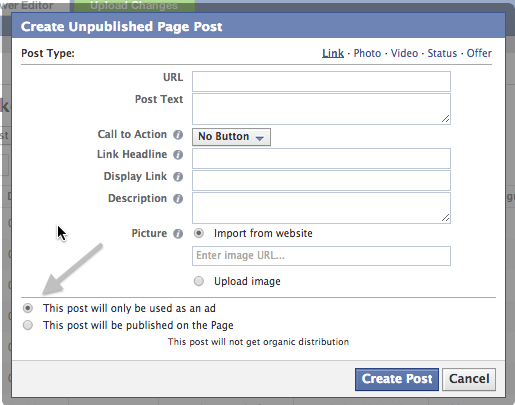
Fire up the Power Editor and start by clicking on Manage Pages and choose the page you would like to create the post for. Now hit Create Post but be sure to click the radio button that says – unpublished post.
Facebook Dark Posts
Now create your post by completing the fields. Remember, this is an ad, so pay close attention to headlines, call to action buttons, descriptions and images that grab. For some of the best advice on successful Facebook ad tactics head over to Jon Loomer’s awesome site.
Once you’ve created your post don’t forget the Power Editor requirement to upload the changes – the button at the top of the editor turns green when you’ve made a change and you have to hit that Upload Your Changes button before you can use this post.
If you are creating multiple posts you can create them all now and simply upload the entire batch. (You can view how your post will look on the desktop and in mobile and I suggest you take this step before uploading the batch)
Once all of your posts are created and uploaded you can switch to your Ad Manager and start creating ads by selecting the appropriate post to use as an ad, select your audience and choose your budget.
One bit of advice, don’t take the Facebook suggested budget. My experience is that you can start much lower and adjust accordingly. I don’t have hard data on this, but since I started refining better for multiple versions, I found my per click costs went down.
You can organize your ads by campaigns and ad groups, a feature that certainly makes sense when you start running lots of ads for different things.
Once your ads are approved you can start monitoring your Ad performance to tweak your tests and improve your results.
Now is the time to get on this tactic as my guess is that sometime in 2015 it will become less effective.
To read the original article Click Here

Thursday, 21 August 2014

25 Vital Facebook Stats for Social Media Marketers

facebook stats header
Facebook is a massive social networking platform that reaches into nearly every aspect of users’ online and offline lives. This networking giant acquires businesses that offer features it doesn’t currently have, and is constantly morphing into something that transcends social media. When you think online marketing, it’s nearly impossible to miss Facebook. In fact, many businesses consider Facebook their only online marketing strategy – although we shouldn’t put all our eggs in one basket - but this reliance on the platform demonstrates just how influential it is.
The follow 25 Facebook stats provide insightful data points all marketers can leverage – whether it’s convincing a client to sign on for a social media campaign or creating facebook-specific content.
  1. There are 1.01 billion mobile active users (MAU) on Facebook. It’s more than likely that your audience is using Facebook on a mobile device. Keep a “mobile first” mentality, and make it easy to access content linked from Facebook. Your website or blog should be ready to handle users who visit your site from Facebook. (Source: TechCrunch)
  2. Mobile advertising revenue represented 62% of advertising revenue in the second quarter of 2014. This is especially interesting information for app developers. Using Facebook news feed ads, you can drive app engagement and installs. Facebook even allows you to link to specific areas of your app directly from the news feed. (Source: Facebook Investor Relations)mobile facebook ads
  3. Ages 25 to 34 represent 29.7% of users and are the largest age demographic on Facebook. This age range represents a prime demographic for most marketers. Your market is there, but you’ll have to do your part to get them engaged with your brand. Find out their needs and what they’re interested in, then craft content that speaks to them. (Source: EMarketer)
  4. Nearly $1.2 billion of Facebook’s revenue comes from US and Canada.
    Facebook is making money because advertisers are making money. A good Facebook marketing strategy can help your brand tap into this income stream. (Source: Bloomberg)
  5. The highest Facebook traffic occurs mid-week between 1 and 3 p.m. Your focus should be on reaching your Facebook audience when they are on Facebook. Use this bit of information to know when and how to schedule your posts and other content on Facebook. If you’re using automated social media posting apps, be sure to keep these timeframes in mind. (Source: Bit.ly blog)
  6. Engagement is 18% higher on Thursdays and Fridays. This, again, is valuable content scheduling information. While engagement is higher, these days also lead into the weekend. Produce content that will stick, so your audience will remember you on Monday. (Source: Bit.ly blog)
  7. Facebook users spent $234 million dollars worth of virtual goods and gifts on Facebook over the last quarter. This is more exciting news for app developers. But this is also good for businesses that use virtual gift cards and gift certificates. If you aren’t yet, it’s definitely worth looking into. (Source: Facebook)
  8. 293,000 statuses are updated, 136,000 photos are uploaded, and 510 comments are posted every 60 seconds. Your job is to get your brand in the midst of all this engagement and activity. If your content is relevant and engaging, users will share it (source: The Social Skinny). For example, MenuDrive – an online and mobile ordering software company – posts originial and thoughtful content on their Facebook page instead of propaganda or advertisements. This type of content is engaging: menudrive facebook post
  9. People search 1 billion times per day on Facebook.
    Drive need and want for your product, service or content. When users feel connected to your brand, they will look for it on social media. Make sure you’re present there when they search. (Source Facebook)
  10. 80% of the top apps on iOS and Android use Facebook Login. There’s good reason for this. Users like the convenience and ease of logging in to an app or website with Facebook. Just having this feature substantially increases registrations. Even in the face of privacy concerns, users still find themselves choosing the useful feature. (Source: Facebook)
  11. Creation of local business pages has increased 100% from 8 million in 2012 to 16 million in 2014. Even small businesses realize the marketing potential of being on Facebook. But presence isn’t enough; you have to reach out to your audience. Before even considering ads, your business should certainly be taking advantage of free pages for business. (Source: Facebook)
  12. Promoted posts totaled 7.5 million from June 2012 to May 2013. This demonstrates, again, that business Facebook users are taking advantage of the huge market Facebook offers. (Source: Facebook)
  13. Businesses spent $2.66 billion on Facebook advertising, which represents an increase from $2.27 billion last quarter. When executed correctly, Facebook ads can drive leads to your business’s website. Just understand that Facebook ads should only be one part of your online marketing campaign.
  14. 654 million people use Facebook mobile on a daily basis, an increase from 609 million last quarter. A large part of your marketing should be geared toward mobile users. Mobile use is on track to surpass desktop use, but many marketers neglect this segment. (Source: Facebook)
  15. Monthly Facebook access increased from 1.28 billion to 1.32 billion since last quarter. This fact just reemphasizes that users are very active on Facebook. (Source: Facebook)
  16. Facebook users are 53% female and 47% male. The key understanding here is that, in a practical sense, there is an equal opportunity to reach both genders. Females edge out male users only slightly. But if you’re brand is seeking a mostly female audience, you’ll easily find them.  (Source: Emarketer)
  17. Facebook revenues totaled $.86 per user from Europe and the rest of the world. If your business has an international audience, your efforts to reach them certainly won’t be lost on Facebook. The mega social media site transcends borders, which is a major opportunity for businesses that want to go international with their marketing.
  18. Users share 4.75 billion pieces of content daily as of May 2013, a 94% increase from August 2012. Again the evidence makes it clear that people are engaged on Facebook, and it only continues to increase. Position your brand by contributing relevant content that is easily shared. Make it easy for website visitors and blog readers to share information with buttons. You can even go so far as encouraging them to do so (source: Facebook). Take the CAT dealer Gregory Pooleas an example of how a seemingly “silo” industry can use Facebook to promote content that isn’t self-serving:poole themed facebook posts
  19.  4.5 billion likes are generated daily as of May 2013. Some of the most liked content on Facebook also has the most comments and shares. While you want likes, comments and shares, aim to get them legitimately. Do this by crafting content that speaks to your audience. (Source: Facebook)
  20. Ad costs per unit have increased 122% since just last year. This has to do with Facebook’s ever-expanding list of acquirements, users and revenues. As they grow, we can expect that ad costs will follow suit. If you’re a small business, take the time to really consider if Facebook ads are the next step for your business. (Source: Facebook)
  21. 1.5 million businesses purchase Facebook ads. Many businesses see the benefit in purchasing Facebook ads. This doesn’t mean that it’s for every business. Also be sure that your ad campaign on Facebook follows through with leads. That includes making sure your ads are really working for you and sending a clear message to potential customers. (Source: Facebook)
  22. The average time spent per Facebook visit is 20 minutes. Facebook users don’t mind hearing what you have to say, but you’d better make it short and sweet. Quality doesn’t equate to length. If the average user is only spending 20 minutes on Facebook in a single visit, make it so that you get your point across quickly. Or make your content interesting enough that they’ll want to save it to read later. (Source: Infodocket)
  23. The average Facebook user spends 40 minutes a day on Facebook. In a whole day, that isn’t very long. Having been bombarded with content and information from friends, family and businesses, you’ll be lucky to be amongst the content the user actually engages with. To increase your chances, create strong content.
  24. Videos are watched and shared on the Facebook news feed twice as much as just six months ago. Diversify your content. While images are still king on Facebook, videos appear to really be taking off, and your brand should take advantage. (Source: Facebook)
  25. 42% of marketers say that Facebook is critical or important to their businesses. Facebook is a crowded place. But you can’t sit back while your competitors are interacting with your audience. The key here is to create a unique space for your brand that users are drawn to and recognize apart from all the others. (Source: State of Inbound Marketing 2012)
As you can see, Facebook’s massive reach offers the audience and the means to contribute and share information. If you want potential customers to notice, take the time to produce content that engages, inspires and informs. These Facebook stats are convincing for many clients who are on the fence about allocating some of their budget to a social media campaign. Before Facebook increases their ad costs again, it would be wise to make the case for clients.
To view the original article Click Here